Pawpaw Seeds and Intestinal Parasites
Pawpaw seeds are one of the few traditional remedies for intestinal worms to be tested in randomised human studies, including in Nigeria. Here's what the research really shows, and what it doesn't.
Pawpaw, or Carica papaya, is familiar across Nigeria as both a food and a traditional medicinal plant. Most of us only eat the sweet orange flesh, but the black seeds are the part with the story.
They have been used traditionally for digestive complaints and intestinal worms. Unusually, they have also been tested in randomised human studies. That is rare for a traditional remedy, and it is why pawpaw seed deserves attention rather than dismissal.
One honest caveat before we start: this evidence is promising, not proven. Nobody should swap a prescribed antiparasitic medicine for a home remedy. What we can do is look closely at the human research, see what it actually measured, understand its limits, and talk about it honestly. We aim to neither dismiss traditional knowledge nor oversell it.
Why Pawpaw Seed Deserves Attention
- A familiar food. Pawpaw is familiar across Nigeria as both a food and a traditional medicinal plant.
- The seeds carry the story. The black seeds have a long traditional history of use against digestive complaints and intestinal worms.
- Tested in humans. Pawpaw seed is one of relatively few traditional remedies for intestinal parasites to be tested in randomised human studies, including research in Nigeria.
- Promising, not proven. The evidence is still preliminary. Pawpaw seed is not a proven replacement for standard antiparasitic medicines, but it is interesting enough to deserve serious attention.
What makes the seeds stand out is that they have been tested the way we test drugs: randomised, with a comparison group, and with laboratory confirmation of infection. Very few traditional plant remedies get that treatment.
It helps to hold two ideas at once. The results are genuinely interesting, and the evidence is still preliminary. Keep both in mind, and you will read every claim about a “parasite cleanse” much more carefully.
The Nigerian Randomised Trial
The key Nigerian study was run by researchers linked to Obafemi Awolowo University and Wesley Guild Hospital in southwestern Nigeria.
- Screen. Sixty children were screened, and all of them had intestinal parasites confirmed by stool microscopy. Nobody was guessing.
- Randomise. The children were randomly assigned to two groups of thirty.
- Treat. One group received an elixir of air-dried, ground pawpaw seeds mixed with honey. The other group received honey alone, which isolates what is actually doing the work.
- Re-test. Seven days later, stool samples were examined again.
The elixir was made by blending 500 g of dried pawpaw seeds and making the mixture up to 1,000 mL with honey. That works out to about 0.2 g of dried seed per millilitre, so a 20 mL dose contained roughly 4 g of dried seed.
Notice what this required: medical screening, confirmed infection and follow-up stool testing. This was a supervised clinical trial, not a home-dose recommendation, particularly for children.
The Results
Seven days later:
- Pawpaw seed + honey: 23 of 30 children (76.7%) had parasite-free stools
- Honey alone: 5 of 30 children (16.7%) had parasite-free stools
That is a large difference, even in a study this small.
Organisms and Caveats
The parasites present in the study included:
- Ascaris lumbricoides (roundworm)
- Entamoeba histolytica
- Necator americanus (hookworm)
- Strongyloides stercoralis
- Trichuris trichiura (whipworm)
- Giardia lamblia
- Taenia saginata (beef tapeworm)
Reported clearance for individual organisms ranged from roughly 71% to 100%. Read that carefully, though. The per-organism figures rest on very small numbers, sometimes only a handful of children, so they are suggestive rather than solid.
The investigators reported no significant adverse effects over the short observation period. But the study was small, and it has not yet been followed by a large Nigerian clinical trial. It is an interesting signal, built on thin evidence.
A Second Human Study: Kenya
A few years later, researchers tested pawpaw seed in schoolchildren in Nandi County, Kenya. This time they used a food-based approach rather than a medicinal elixir.
- 326 children from three primary schools in Nandi County
- About 10 g of seed per day in 300 mL of porridge, given for two months
- Three groups compared: pawpaw-seed-fortified porridge, ordinary porridge, and ordinary porridge plus albendazole, the standard deworming medicine
That third group matters, because it gives us a benchmark against established treatment. The most common parasite identified was Ascaris lumbricoides. The approach was designed as something you could actually cook.
The limitations are real, though. The study was preliminary, whole schools rather than individual children were assigned to treatment groups, and the trial was retrospectively registered. Keep that in mind when reading the results.
Two Human Studies, Side by Side
| Feature | Nigerian trial | Kenyan school study |
|---|---|---|
| Participants | 60 children | 326 children, three primary schools |
| Parasites confirmed by | Stool microscopy | Stool microscopy; schools assigned to groups |
| Preparation | Air-dried ground seed elixir with honey | Maize–millet–seed porridge |
| Dose & duration | ≈ 4 g dried seed in 20 mL, single dose | ≈ 10 g seed per day in 300 mL, two months |
| Comparison group | Honey alone | Ordinary porridge; porridge + albendazole |
| Main result | 76.7% vs 16.7% stool-negative at day 7 | 63.9% Ascaris egg reduction vs 78.8% with albendazole |
| Caveat | Small; not yet replicated | Preliminary; retrospectively registered |
The contrast teaches us something. The two studies had different scales, different durations and different ways of delivering the seed.
They also measured different outcomes. The Nigerian trial measured stool negativity, meaning whether the infection cleared. The Kenyan trial measured egg-count reduction, which describes egg output rather than cure. In Kenya, the fortified porridge produced a 63.9% reduction in Ascaris egg counts, while albendazole achieved 78.8%.
That gap is meaningful. It does not mean pawpaw seed is equivalent to albendazole. It means the seed showed real activity worth investigating, within a preliminary study that had genuine design weaknesses.
Neither study establishes a home dose. Both were supervised research interventions with screening and follow-up testing.
Why Might the Seeds Affect Parasites?
Pawpaw seeds contain several biologically active compounds:
- Benzyl isothiocyanate (BITC), which has received considerable attention
- Phenolic compounds
- Flavonoids and other secondary plant chemicals
Researchers have suggested that some of these may contribute to the antiparasitic effects observed. The honest answer, though, is that we do not yet know which combination of compounds is responsible for the effects seen in people.
That has a practical consequence: preparation matters. Fresh seeds, air-dried seeds, powdered seeds, fermented seeds and chemical extracts should not be assumed to have identical biological effects.
When you see confident online claims about exactly how pawpaw seed kills worms, remember that the underlying chemistry is still an open question.
Preparations Actually Studied in Humans
Instead of inventing a cleanse, it helps to look at what people were actually given.
1. Seed powder with honey (Nigerian pilot trial)
- Seeds removed, air-dried, then ground or blended
- Powder combined with honey: 500 g dried seed made up to 1,000 mL with honey (≈ 0.2 g/mL)
- Research dose: about 4 g dried seed in 20 mL
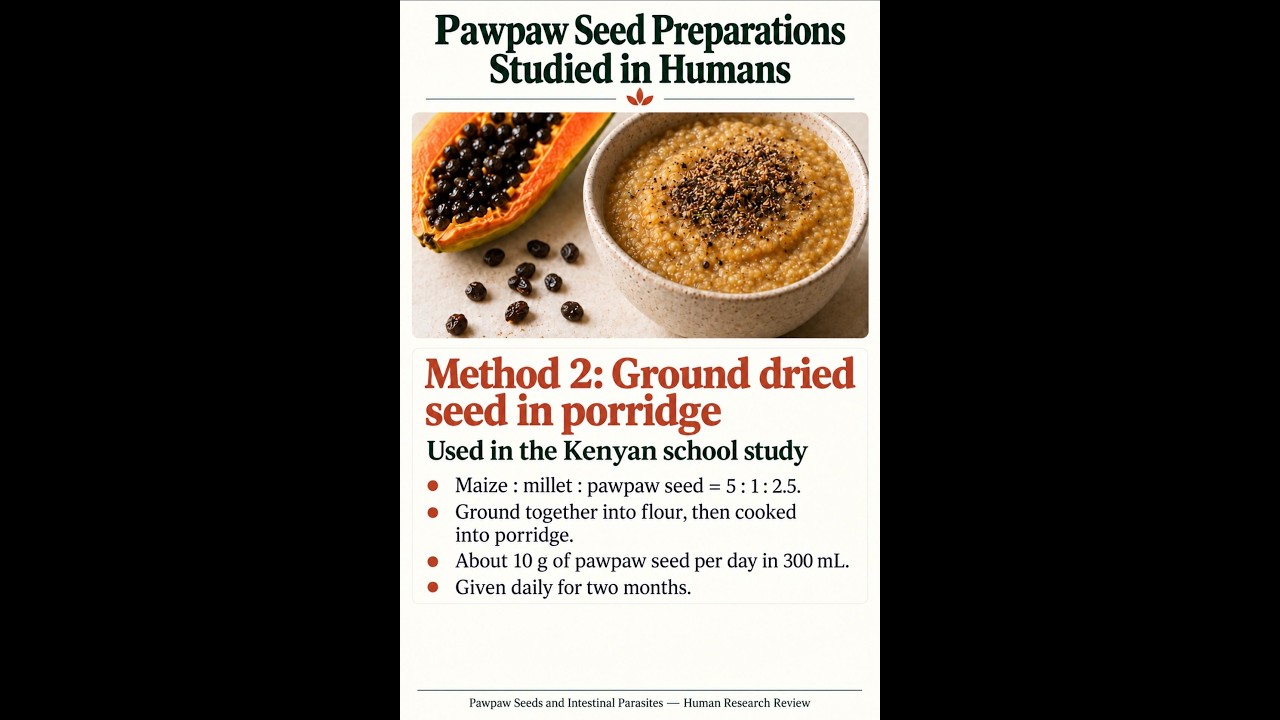
2. Ground seed in porridge (Kenyan school study)
- Maize, millet and dried pawpaw seed combined in a ratio of 5 : 1 : 2.5
- Ground together into flour, then cooked into porridge
- About 10 g of pawpaw seed per day in 300 mL, given daily for two months
For ordinary food use, the sensible version is simpler. Remove the seeds from a ripe pawpaw, rinse off excess pulp, dry them thoroughly, grind them to a coarse powder, and use small culinary quantities. The taste is strongly peppery and slightly bitter.
Both research preparations were supervised interventions, not dosing guidelines. Neither study gives us a universal safe daily dose.
What the Honey Comparison Tells Us
Why does the honey combination keep coming up? Partly taste. The seed powder is intensely bitter and peppery, and honey makes it easier to take. The research does not prove that honey itself improves the antiparasitic action.
We can say that with some confidence because the comparison group in the Nigerian trial received honey alone. Only about 17% of those children cleared their parasites, against roughly 77% in the seed group. If honey were doing the work, both groups would have looked similar. They did not.
So the effect observed was associated with the pawpaw seed preparation rather than the honey. Honey’s role here is palatability, which is helpful, but it is a different thing.
For Suspected Parasites: Test First
Step 1: Find out whether a parasite is actually present.
Symptoms often blamed on parasites include:
- Abdominal discomfort
- Diarrhoea
- Constipation
- Bloating
- Unexplained weight loss
- Itching
- Anaemia
- Fatigue
These symptoms can have many causes other than parasites. A stool examination or other appropriate medical testing can identify the organism.
Step 2: Treat the organism that is there.
Treatment for Ascaris is not necessarily the same as treatment for Giardia, Strongyloides, tapeworms or amoebiasis. If an infection is diagnosed, an appropriate antiparasitic medicine remains the best-established treatment.
Pawpaw-seed research can absolutely be discussed with a qualified healthcare professional as an emerging complementary approach, not a replacement.
Test first. Identify the organism. Treat with established medicine. Discuss alternatives with a professional.
Why Not a Long-Term Pawpaw-Seed Cleanse?
Look at what the studies actually did:
- Nigeria: one dose. A single administration, with follow-up after seven days.
- Kenya: two months. Daily fortified porridge under a research protocol in schoolchildren, with monitoring.
Neither study establishes that healthy people should take medicinal quantities of pawpaw seed continuously.
There is more. Animal studies suggest concentrated pawpaw-seed extracts can influence male fertility and sperm function, and other animal research raises reproductive concerns at sufficiently high exposures.
Animal findings do not prove these effects occur at ordinary food quantities in humans. They are, however, sufficient reason not to present heavy or prolonged consumption as harmless.
Who Should Take Extra Caution
Take extra caution with concentrated medicinal use of pawpaw seed in:
- Pregnancy
- Breastfeeding
- People trying to conceive
- Children outside medical supervision
- People with significant liver, kidney or gastrointestinal disease
What We Can Confidently Say
The evidence is encouraging, but still limited.
- Nigerian pilot: around 77% became stool-negative with the seed-and-honey preparation, compared with about 17% with honey alone.
- Kenya: a 63.9% reduction in Ascaris egg counts after two months with fortified porridge, compared with 78.8% with albendazole.
Together, the studies suggest pawpaw seed contains compounds worthy of further development as an antiparasitic intervention.
What the Studies Still Do Not Tell Us
- The optimal dose for adults, or for children of different ages
- The safest duration, and whether repeated courses are safe
- Whether fresh and dried seeds work equally well
- Which parasites respond best, and whether pawpaw seed prevents reinfection
- How it compares with modern antiparasitic medicines in adequately powered trials
That long list should keep us honest.
Where Traditional Knowledge and Modern Research Meet
The bigger lesson is that a traditional food produced a measurable biological effect under scientific testing. That is where tradition and research meet.
The next step should be larger, carefully designed clinical studies in Nigeria and elsewhere, with:
- Standardised seed preparations
- Parasite identification
- Toxicity monitoring
- Comparison with established treatments
Until then, pawpaw seed remains a promising candidate, not a proven deworming remedy.
Blooms Keen Health — reconnecting traditional wisdom with evidence-informed health education.
This article is for educational purposes only and is not a substitute for medical advice, diagnosis or treatment. If you suspect a parasitic infection, please speak with a qualified healthcare professional and arrange appropriate testing.